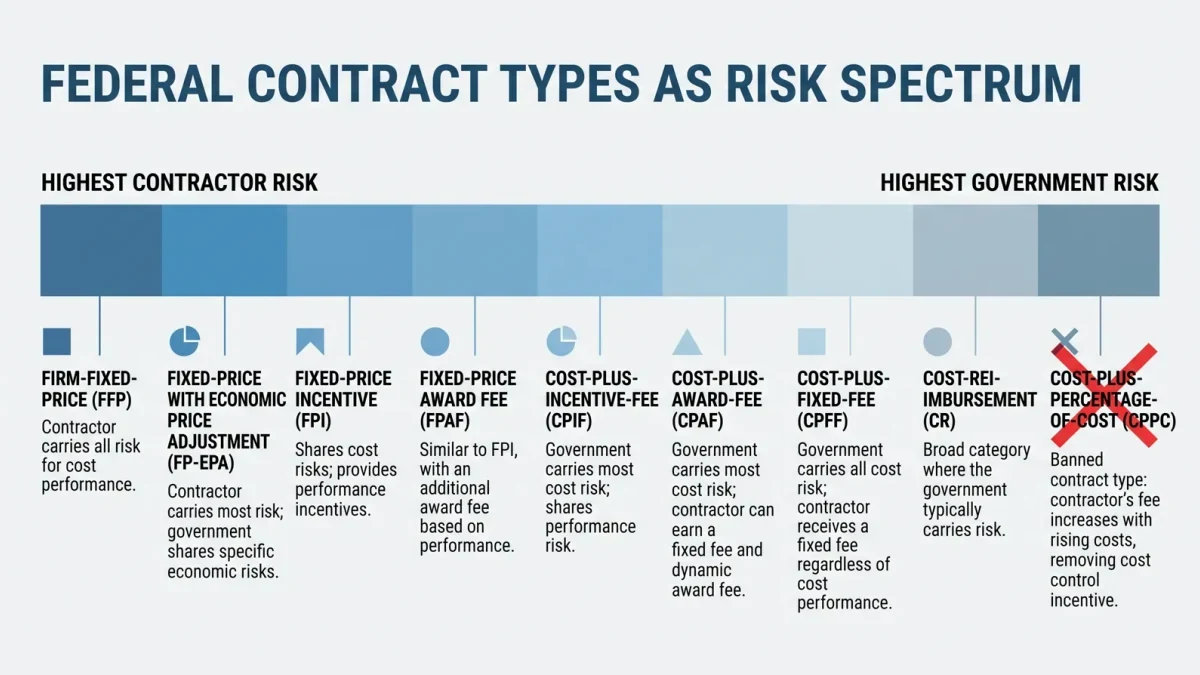
Every federal contract allocates risk between buyer and seller, and the Federal Acquisition Regulation's contract types are the allocation instruments. Firm-fixed-price places all cost risk on the contractor: the price is set, overruns are the vendor's loss, underruns the vendor's gain. Cost-reimbursement places cost risk on the government: the agency pays allowable, allocable, reasonable costs plus a fee, and the vendor's downside is bounded by the contract's ceiling. Between them sit incentive and award-fee hybrids that share risk by formula. The regulation's rule — cost-reimbursement only when uncertainties prevent estimating costs with sufficient confidence to use fixed-price — sounds simple, and the entire discipline of federal contracting strategy lives in its application.
When each type is right
Firm-fixed-price suits commercial items and well-defined requirements: the FAR mandates it for commercial products and services, and it dominates routine buying. Cost-reimbursement suits genuine uncertainty — research and development, first-of-kind engineering, emergency response where scope cannot be known — because forcing a fixed price on unknowable work just moves the risk into a padded bid or a default. The Government Accountability Office's acquisition reviews apply the test repeatedly: agencies using cost-type contracts for definable work pay for the privilege, since cost-plus vendors have weaker incentives to control costs, and GAO's decades of major-systems reporting document the overruns that predictably follow. Time-and-materials and labor-hour contracts, the third family, price labor rates and materials at cost plus marked-up rates — a last resort under the FAR's Part 12 constraints, appropriate only when hours cannot be estimated.
Related stories: IDIQ Contracts: Why Government Buys From Menus It Hasn't Priced Yet · CPARS: The Report Card That Follows Every Federal Contractor.
Why cost-plus gets abused, and what it costs
The abuse pattern is definitional drift: a project starts as research (cost-type appropriate), matures into production (cost-type inappropriate), and nobody converts. Conversion requires re-negotiation, re-competition often, and admitting the requirement is now stable — institutional friction that the Government Accountability Office has flagged on major acquisition programs for decades, where development contracts slide into production years without fixed-price conversion. The measurable consequence: cost-growth statistics on major systems routinely exceed original estimates, and the fee structure — cost-plus-fixed-fee caps profit but pays fee on incurred costs — blunts the overrun brake. Award-fee contracts were meant to fix this with performance-contingent fees; GAO reviews found agencies paying award fees regardless of performance often enough that the FAR was amended to tighten award-fee practice.
The forbidden rung
One contract type is barred outright: cost-plus-percentage-of-cost, where fee rises as a percentage of every dollar spent — a structure the regulation prohibits because it rewards spending more rather than less. The prohibition is old and absolute, and its reappearance in disguised form — layered incentive structures that functionally increase fee with cost — is what auditors watch for in fee-structure reviews. The reason is arithmetic: any arrangement that pays the vendor more for spending more converts cost control from an incentive into a penalty.
FAQ
What is a firm-fixed-price contract?
A contract with a set price not subject to adjustment based on the contractor's cost experience — the contractor keeps savings and absorbs overruns, carrying all cost risk.
When may the government use cost-reimbursement contracts?
When uncertainties prevent estimating costs well enough for a fixed price — research, first-of-kind development, emergency work — with cost risk on the government and allowable costs paid plus fixed fee.
Why are cost-plus-percentage-of-cost contracts banned?
Because fee growing with cost rewards spending more rather than controlling it — the FAR prohibits the structure outright and auditors watch for disguised versions.